Tuesday, November 17, 2009

More updates on the Busan fire, a preventable tragedy.

Here are a few updates on the fire in a Busan shooting gallery (부산 사격장 화재) that killed seven Japanese tourists and three Koreans on Saturday, and which is among the top headlines in the country. You'll find a collection of Korean-language news via Naver; as far as the English papers go, the Korea Times has the headline "Busan Fire — Disaster Waiting to Happen," and writes:
Police are suspecting that the blaze that claimed nine lives overall was caused by a cigarette. "Given that the gun range allowed smoking, we are looking into the possibility of this activities role in the accident," Kim Jung-hwak, chief of the Busan Jungbu Police Station said during a press conference Monday. Police have been conducting an investigation at the shooting range since the weekend and are yet determine the exact cause.

Citing Japanese tourists that had used the shooting range, a Japanese newspaper observed that its sound-proofing structure had made it difficult for smoke to escape in case of a fire. Tourists also said that the building was old, had low ceilings and poor ventilation, making it susceptible to fire.

It continues
The Korean government issued an apology for the incident and is expected to take due compensatory measures. "We will take proper measures to deal with the aftermath of this incident and come up with policies to prevent future occurrences," Yoo In-chon, minister of culture, tourism and sports, said.

Noting that the fire could have been avoided with stricter adherence to safety measures, President Lee Myung-bak urged a review of standards nationwide. "We must take this incident as an opportunity to raise our consciousness about safety throughout our society. Such efforts should not be limited to the tourism industry," the President said during a weekly meeting with his top aides.

The Korea Herald article, which kind of jumps all over the place, reads in part:
The Japanese government and media expressed appreciation for the sincerity of the Korean government, but nevertheless pointed out that safety levels were sub-standard.

A five-story building in a Busan marketplace was engulfed in a sudden blaze following a loud blast at around 1:26 p.m. on Saturday, according to witnesses. On the second floor was an indoor shooting range, a tourist spot which had recently become very popular among Japanese visitors.

The 10 victims died on the scene from burns and six more, three of them Japanese, were injured and taken to nearby hospitals.

The death toll may possibly rise as the injuries are critical, said the police.

The tourists had come from the Japanese town of Nagasaki to the port city earlier that day for a two-day school reunion trip.

Some 37 distressed family members of the Japanese victims arrived in Busan to verify their identities.

Meanwhile, the police are struggling to find the exact cause of the fire.

"One of the possibilities is that there might have been an explosion caused by leftover gunpowder and cigarette smoke," said a police official.

Yesterday the Joongang Ilbo wrote:
Japanese media were critical of the lax safety measures at the shooting range where the fire occurred. The Asahi Shimbun noted that opening an indoor shooting range in Korea requires strict standards for firearm safety and soundproofing, but that fire prevention tends to take a backseat.

The Yomiuri Shimbun reported that the burned-down Busan range had no windows and only two exits. It quoted an Osaka man who had visited the range in the past as saying, “It was such a closed-off place that it would have been difficult to escape if there had been a fire.”

The Chosun Ilbo has an editorial, "Fatal Fire at Shooting Range Another Avoidable Tragedy":
It is frustrating to see the continuation of tragedies caused by poor safety measures in Korea. There have been eight major fatal fires since 2000, including one at a mental hospital in November of 2000 that killed eight people, another at a private crammer in Gwangju that killed eight in 2001, and a blaze at a bar in Gunsan in 2002 that left 12 dead. In 2003 a fire set by an arsonist inside a subway train in Daegu killed 192 people, while a blaze in a mental hospital in South Chungcheong Province in 2006 left five dead. In 2007, nine foreigners who had entered Korea illegally were killed in their holding cells when a fire broke out at an immigration office in South Jeolla Province. And in January and December of 2008, 47 people were killed after fires burned two cold-storage facilities in Gyeonggi Province. The locations and types of fires may be different, but they were all caused by the same reason: a lax attitude toward safety regulations designed to protect human lives.

The latest tragedy occurred at a shooting range that was located on the second floor of a five-story building. People could have jumped out of the windows and survived, but anti-theft steel bars on the windows trapped the victims inside and thick sound-proofing materials prevented smoke from flowing out. Nevertheless, the structure passed a fire safety inspection conducted on Nov. 6. In April of 2006, a fire at a shooting range in Seoul killed one worker and injured seven, including three Japanese tourists. Less than four years later we have a far greater tragedy in another shooting range.

The Korea Times editorial is titled "Tragic Fire":
Saturday's fire killing 10 people has added fuel to the nation's notoriety for disregarding safety and prevention measures against potential risks for human lives and properties. It is all the more tragic that seven of the victims were Japanese tourists. What a pity it was to see that their visit to Korea became the last moment of their life? We extend our heartfelt condolences to the bereaved families of those killed in the blaze.

It concludes, continuing to worry about tourism and Korea's goddamn international image:
In particular, the shooting range fire is feared to have negative implications on the nation's tourism industry and its international image. Prime Minister Chung Un-chan visited a morgue at a Busan hospital to extend his condolences and apologize to the families of the victims. It was coincident that the fire took place on the same day when a gala ceremony was held in Seoul to celebrate the ``Visit Korea Year'' campaign for 2010 to 2012. Now, it's time for the nation to take revolutionary steps to prevent a recurrence of such a fire-induced tragedy.

On my last post about the fire, I mentioned how bad fire safety awareness can be here, citing as one example my school chaining all but one of the doors shut.


Others chimed in yesterday with comments. Earlier in the year Brian Dear wrote:
I was at Soonchunhyang University in 2002-2003 and they chained the emergency exits there too. Of course, being uncooperative with curfews and being trapped in a potential firebox, I picked the padlock and simply used a dot of glue to hold the lock together so it looked locked. Sometimes, you have to take your own safety in your hands. Buy your own smoke detectors, etc. That fire-exit locking business is a major, major tragedy waiting to happen.

Yesterday kwangdongbrian wrote:
My university and a private high school I have worked at both locked their doors at night.

And provided a link back to his own pictures of deplorable fire safety. 3gyupsal wrote:
I worked at a university that would chain the doors closed on the dormatories to prevent students (and teachers) from comming and going after a 12:00 curfew. Students who wanted to stay out or leave had to sign a piece of paper (Ironic given that they were college students.)

Puffin Watch wrote:
My school was divided in the middle with glass doors. The middle schoolers were on the other side. As was the only other exit in the event of fire. Of course they'd chain the doors during class time so the middle schoolers would not come over to the other side and make noise or something.

No one gave much thought to fire safety, of course. We were 8 floors up and no fire extinguisher had a needle on green. And of course all the fire flashlights had zero battery power as they were toys for the kids.

My thought was in the event of fire, I would probably be the first one to pick up a desk and hurl it through the locked glass doors.

And kushibo wrote about his experience in the 1990s:
At the international dorms at Yonsei the fire exits on each floor were blocked, as were the doors that connected the south wing (where the guys lived) and the east wing (where the girls lived).

The guy who ran the place was adamant that was not going to change. He wanted to make sure people obeyed curfew, and he didn't want guys and girls sneaking into each other's rooms and having sex.

I've turned off comments here, so please post them on yesterday's thread for the sake of keeping things organized.

Talking about the "'World Series" in the Joongang Ilbo.

Today's Joongang Ilbo column is compiled from comments to the post "Should the 'World Series' change its name?" I think Nathan Schwartzman
"Should the top sumo wrestler in Japan not be considered the world champion, despite there being sumo in other countries?” asks Nathan Schwartzman. “National teams like those which compete in the Olympics or WBC [World Baseball Classic] are really just assemblages of talent tossed together for brief periods of time. Comparing national teams and professional teams is really apples and oranges.”

and J
“Major League Baseball teams are ‘North American,’ but their players represent many countries. Close to 30 percent of players are not from the United States,” J writes. “Do the people in Korea who complain about American ‘arrogance’ know that so many players are not from North America? Korean and Japanese baseball leagues place limits on the number of foreign players that can play on a single team. The ‘arrogant’ American teams do not have such xenophobic policies. The MLB and its fans are more focused on the skill of players.”

put it best.

Monday, November 16, 2009

Hines Ward's "Helping Hands" and charitable work for biracial Koreans in the news.


Hines Ward with biracial Korean fans at Heinz Field vs. Minnesota; via the official Steelers website.

This was an interesting read in the New York Times, about Pittsburgh Steelers receiver Hines Ward and his efforts to help biracial children in South Korea; here's an excerpt:
Steelers receiver Hines Ward surrounded himself with old friends at the dinner table on a recent Saturday night. The bond was as obvious as the look on everyone’s faces — half Korean, half something else. The shared experience was far more than skin deep.

There was a boy who was bullied into depression and tried to commit suicide. There was a girl ordered by a teacher to keep her hair pulled back tight, to straighten the natural curls she inherited from her black father. There was another too intimidated by her taunting classmates to board the bus, choosing instead the humiliating and lonely walk to school. There were the boys who were beaten regularly and teased mercilessly. There were college-age girls who broke into tears when telling their stories of growing up biracial in South Korea.

But when they looked around the table, they saw familiarity. And a future.

“It is so special that no one is staring at me, and no one is asking me about my hair,” Lisa So, 20, said. “It gives me hope.”

The eight boys and girls, between 16 and 21, were visiting Ward from South Korea, where people of mixed races are considered everything from a curiosity to an abomination. What starts with teasing from childhood peers often turns to widespread ostracism and discrimination. It eventually leads to higher dropout, poverty and suicide rates.

“It’s a great culture,” said Ward, who was born in Seoul to a Korean mother and an African-American soldier father, and was raised mainly in Georgia by his mother. “I love everything about it. But there’s a dark side to that culture. And me, I’m just trying to shed a light on that dark side and make Korea a better place than it already is.”

There were a few articles in Korean at the time: two of the longest are from the Segye Ilbo and from Yonhap. A few days ago Newsis covered the New York Times coverage, calling the paper the NT팀스.

Little mention was made in the Pittsburgh media, save for a repost of the NYT article, and this interesting tidbit in the Pittsburgh Post-Gazette on November 8th:
No one puts on a better charity event than Deshea Townsend. In the past, he has had garage sales where his teammates brought something from their garage for auction. He never did get that Porsche one promised.

This year, he's going after their heads, their helmets, to be precise for his "Black & Gold Art Show" Nov. 23 at Tusca restaurant in the SouthSide Works. Steelers players have either designed or painted their own helmets in unique ways, then autographed them.

Among the more interesting are a certain quarterback's helmet that is painted like a golf ball and has "Roethlisberger 7" on it. Hines Ward had his South Korean kids, who visited a few weeks ago, paint Korean words on his helmet.

You'll find a lot of pictures on the Steelers official site by clicking here, going to the "events" tab, and clicking on the gallery for "2009 Hines Ward Helping Hands Visit."


Unfortunately, I could find no pictures of the helmet, but I hope something turns up after the auction.

Something that was interesting to read were the essays written by students chosen to come to Pittsburgh. You'll find them on the Steelers site, linked to by this write-up of this year's visit. Here's an excerpt from the essay written by Han Min-yeok:
I was born between a Korean mother and American father, which gave me a lifelong tag called “Half-blood”. Growing up in Korea as an Amerasian child required a painful life caused by prejudice and racial discrimination. Kids poured ridicule on me and adults thought that being half-blood itself is reprehensible. Thus, other kids made the wrongs, but their parents blamed me. In these results I asked myself, “What have I done wrong? Why do people hate me?” but I couldn’t find an answer. Moreover, as I became older, prejudice became stronger and people became violent towards me. These events made me very timid and wary towards people, which led me to believe that I am nobody and my life is superfluous. But after I heard about Hines Ward, my heart started to change. The life I lived was painful enough to make me think negative towards the world, which made me believed that half-bloods cannot be successful in this society. However, in 2006, a man named Hines Ward who is half Korean and half American was broadcasted in the news for being the MVP of the Super Bowl game. This brought a great impact to Korea. Many Korean’s misconception towards half-blood changed dramatically, and people started to receive us and understand us as part of them. It was a dream for me that an Amerasian can also be part of the society, but by this event, my dream was about to come true. As a result, I gained hope and courage which made me believe that I can also live my life in pride and that I am also part of this world and I am not a superfluous being.

After time passed by, I gained an opportunity to meet Hines Ward by a group called Pearl S. Buck. Hines picked 8 kids from Korea for trip to America, and I was one of them. My heart fluttered with excitement by the thought that I can meet my hero, who changed my heart from inside out. Moreover, it was my first flight, which made me extra exited. As I imagined, he was a great man, who had the strength to overcome the pain that he went through, and had the hope to gaze upon the future. He went through the same pains and sorrows just like the other half-bloods. But he was strong, and he did not give up. He showed me through himself that if I try my best for the things that I want to do, I will succeed.

At the last day, he told me, “Never give up, Your special. Never be controlled by others but you control yourself”. I will never forget this sentence. He lighted my life and gave me a hope to carry on. A timid little boy who believed that he would always be by himself, now stands straight towards society with the hope given by Ward, lives his life with pride.

The blog ROK Drop has done the best job of covering Ward's charitable work with biracial Koreans since becoming a national icon here. For instance, here's a link to a Peter King CNNSI article from last November, found via this post:
For the third year in a row, the Hines Ward Helping Hands Foundation is hosting a group of bi-racial South Korean children (there are 11 this year, between 6 and 14) in Pittsburgh. The goal is to build confidence, self-esteem and a strong work ethic in the children, who are often looked down upon by some in their homeland who value racial purity.

Ward has found five families in Pittsburgh who play host to the kids for a week, and he eats dinner with them, takes them to a Steelers’ game and shows them the sights, like the Carnegie Science Center. Ward is the child of a black American serviceman and a Korean woman, and he moved to Georgia as a young child. His current effort stems from a visit he made to Korea as a hero after he was named the Super Bowl MVP three years ago, and a visit he made to a group home for bi-racial children without parents in their lives.

“They were kids left behind, either by servicemen or moms who couldn’t take the prejudice they felt in the society,” said Ward. “My mom was an outcast because she went outside her race to have a child. That’s one of the reasons she moved. When I was there [after the Super Bowl], everyone praised me for my accomplishments, but they shunned the kids. So I wanted to do something to let bi-racial kids know they can have positive lives.”

And a Stars & Stripes article from 2007, found via this post:
Eight Amerasian children from South Korea spent a week in America at the invitation of Pittsburgh Steelers wide receiver Hines Ward.

Ward paid for the children’s air fare and other expenses, said Bae Kyung-hee, an official from Pearl S. Buck International, an organization founded in the mid-1960s to help Asian children who were not eligible for adoption.

The organization assisted Ward in bringing the children to the United States, where they stayed with host families and watched the Steelers play the Jacksonville Jaguars on Sunday.

The children were slated to return early this week.

Ward, whose mother is Korean and whose father is a black American, was voted most valuable player of the Super Bowl in 2006, the first Korean-American to achieve that honor. The 31-year-old was born in Seoul and has been an advocate for the rights of biracial children in South Korea, according to an article in the Pittsburgh Post-Gazette.

The children wrote essays talking about their lives and their dreams prior to visiting Ward.

“You and I have something in common,” said one child. “It was hard for your mother to raise you and it is hard for my mother to raise me too. Because I do not want to make it any harder for my mother, I study very hard, so I can be just like you.”

And a Pittsburgh Post-Gazette article about the first such visit in 2006:
"Christmas came early for me this weekend," a smiling Mr. Ward said as he greeted the children, ages 9 to 16, and the local families with whom they are staying during their time in southwestern Pennsylvania.

Hines Ward meeting South Korean President Lee Myung-bak in Pittsburgh in September, from Yonhap via Naver via this post, which has links about his charitable work in South Korea.


No reason, I just really like these throwback jerseys.

Hines Ward is an excellent symbol for Pittsburgh, and a man I hope the city fully appreciates, not simply for his blocking. Give him a key to the city, or whatever it is people do nowadays, for his humanitarian work and for all he's done to give Pittsburgh a good name with millions of people over here.

알 유 아 굿 다운로더?


A recent example of excessive "English" use in Korea, the "굿 다운로더" (Good Downloader) campaign.


Commercials featuring Korean actors are discouraging people from illegally downloading movies. There are a bunch available on Youtube, including:


Ah, I meant to write "discouraging people from illegally downloading Korean movies," because the Naver page, this "Good Downloader" page, and that commerical are referring to Korean ones.


The campaign isn't that new, but I've only started seeing the commercials on TV. From a Korea Times piece last month:
The anti-piracy campaign, ``I'm a Good Downloader,'' featuring top Korean stars garnered much interest Friday afternoon at the outdoor stage of the PIFF Village. Hallyu star Jang Dong-gun, who appears in the festival's opening film ``Good Morning President,'' and actresses Ha Ji-won and Uhm Jung-hwa, heroines of ``Haeundae,'' took part in the event.

"Haeundae recently suffered from piracy. This negatively affects our country as a whole, and I hope this can be an opportunity to change our downloading habits,'' said Ahn Sung-ki, veteran actor and director of the campaign.

This is Korea, and of course people will be concerned with protecting the local market. However, the hubbub over illegal copies of Korean movies online is especially ironic, considering South Korea is where copyright comes to die and is, dare I say, a "hub" of piracy. In September, as Chris in South Korea has written, the local entertainment industry was angry about illegal copies of the movie Haeundae available in China:
The Korean film industry is seething after a copy of the blockbuster "Haeundae" was found being illegally distributed over the internet last weekend, especially since the film had galvanized the industry by becoming the fifth Korean film ever to draw over 10 million viewers. Public calls for strong legal action against piracy are gaining support, but it might be too late to stop the spread of the bootleg overseas as it is already circulating on Chinese websites.

However, a trip to Seoul will show how easy it is to find bootleg copies of all the top movies, as you'll find vendors on busy intersections selling four for 10,000 won. Hell, at E-Mart last year I bought a copy of a Nintendo 64's "Mario Kart 64" ripped to a CD-ROM. Piracy is so rampant here that in 2008 both Warner Brothers and Sony have shut down DVD distribution in South Korea (though Warner Brothers has done what it needs to do to survive in this day and age). From the Korea Times last year:
Although Internet piracy is more of a concern, movie studios are frustrated about the private DVD copies sold on the streets. Street vendors camped in front of subway stations selling three to four private copies for a single 10,000 won bill are almost part of the landscape. In the film council’s survey, 8.1 percent of respondents said they have bought pirated DVD copies on the streets at least once.

This is to say nothing of piracy and "borrowing" of overseas music, pornography, software, designer brands, textbooks, and other intellectual property here. It's a little crass and hypocritical to worry about copyright infringement only when it concerns Korean products. People are taking the angle now that illegal downloading hurts Korea's film industry, but perhaps they could adjust that a little to hit on another common theme: __________ is bad for Korea's international image. Not simply because stealing makes Koreans look like, well, thieves, but because it discourages big companies (Sony, Warner Brothers, Nintendo) from bothering with the country at all.

Sunday, November 15, 2009

More on Busan shooting range fire; Korea Times reports death of Japanese tourists in Busan fire bad for tourism.

The Korea Times reports on the death of Japanese tourists in a Busan fire yesterday, under the headline "Shooting Gallery Fire Shows Lows of Tourism Initiative." The death of tourists seems to indeed run counter to the Korea Tourism Organization's aims.
A fire Saturday killed 10 people including eight Japanese tourists at an indoor shooting range in Busan, the nation's second largest city.

By tragic coincidence, on the same day, a gala ceremony was held in Seoul as a pre-celebration for the "Visit Korea Year" campaign for 2010 to 2012.

The two events display the conflict between high hopes and harsh reality. A high-powered cast including first lady Kim Yoon-ok was on hand to celebrate tourism here, but at the same time the most basic necessity of the industry ― safety ― was not even guaranteed. Some critics say that Korea needs to improve safety and other basic necessities rather than holding galas if it wants to draw 10 million tourists annually by 2012, the last year of the campaign.

The Korea Times closes with:
Japanese are one of the largest groups of foreign visitors. The Korea Tourism Organization expects the number of inbound Japanese travelers to reach three million by the end of the year, accounting for nearly 40 percent of the total visitors here.

To make Korea more attractive to foreigners, the government Friday unveiled a package of plans to draw 10 million visitors on an annual basis by 2012. Seoul Mayor Oh Se-hoon said in his opening speech: "With 75 percent of travelers visiting Seoul, how well Seoul does decides virtually all. I, as a head of Seoul, will do my best." The gala featured, among others, first lady Kim Yoon-ok, honorary chairwoman of the Visit Korea campaign; Culture, Sports and Tourism Minister Yu In-chon and Lee Byung-hun, the top actor starring in the current hit TV thriller, Iris. A number of boy bands and girl groups also performed at the event.

What's also bad for attracting foreign tourists is designing websites entirely in Korean, and using shitty English slogans like "Visit Korea Year: 2010-2012."

The story is all over the Korean news now, and Naver has a round-up of articles, though there's been little released in English thus far. The Korea Times has this excerpt,
Firefighters said the only exit was just 10 meters away from a room where seven people were found dead.

"It's unclear why the victims failed to find the way leading to the exit," a firefighter said at the scene. "Its structure is quite simple so it's not that difficult to find the exit."

while the Korea Herald writes:
Fire authorities had reportedly warned owners of the shooting range during a recent inspection of potential dangers because of the large amount of soundproof material at the facility that would produce heavy toxic fumes in case of fire.

And, as an update to the original post, I'll add Monday morning's Joongang Ilbo piece, which writes:
Japanese media were critical of the lax safety measures at the shooting range where the fire occurred. The Asahi Shimbun noted that opening an indoor shooting range in Korea requires strict standards for firearm safety and soundproofing, but that fire prevention tends to take a backseat.

The Yomiuri Shimbun reported that the burned-down Busan range had no windows and only two exits. It quoted an Osaka man who had visited the range in the past as saying, “It was such a closed-off place that it would have been difficult to escape if there had been a fire.”

Some of the television news reports I've watched have brought up other similar fires, including this SBS report which mentions a 2006 fire in a basement shooting range in Seoul in which seven died. Reading what's written in the Herald reminds me immediately of the fire at the Yeosu immigration detention center (1, 2, 3); a Korea Times article quoted by Gusts of Popular Feeling says
[Firefighters] failed to put out the fire early because each detention room was blocked with iron bars to prevent detainees from fleeing. It is believed that the high number of deaths was due in large part to the detention center's floors, a fireman said. The floors, which were said to have contained urethane, emitted toxic gases when on fire.

Fire safety is frightening in Korea, and you may have noticed a couple weeks ago that part of Chonnam National University's measures against swine flu involve chaining all but the front door in the language center shut.


I mentioned in a post eighteen month ago the practice of chaining university dormitory doors shut at night, to which Sonagi replied:
It was true while I was in Korea. I taught at two universities in Seoul, and both chain-locked the doors at night.

and Brian Dear wrote:
I was at Soonchunhyang University in 2002-2003 and they chained the emergency exits there too. Of course, being uncooperative with curfews and being trapped in a potential firebox, I picked the padlock and simply used a dot of glue to hold the lock together so it looked locked. Sometimes, you have to take your own safety in your hands. Buy your own smoke detectors, etc. That fire-exit locking business is a major, major tragedy waiting to happen.

and gordsellar wrote:
I suppose the real issue is that no dorms have burnt down. A few prostitutes dying because of being chained inside a brothel (was that 2002? 2003?) didn't catch people's attention so much, but a dorm full of students, that might actually wake people up. Sad.

Deaths of prostitutes, brown people and English teachers in fires hasn't raised many eyebrows, but now that a group of Japanese tourists have died, perhaps this will be sufficiently bad for Korea's international brand to prompt some change. The television coverage at least suggests people are paying attention.

Taking the fight against "Anti-English Spectrum" to Naver.

Andrea Vandom, who made news earlier in the year for challenging the legality of the health checks required of English teachers on E-2 visas, has sent a letter to NHN Corporation, the parent company of South Korea's largest portal Naver.com, regarding the online cafe "Anti-English Spectrum." The activities of Anti-English Spectrum, specifically "Spectrumgate" and their crusade against interracial relationships is a huge part of "our" collective history over the last decade; relevant links on the group and their actions are further down the post.

She has published her full letter on her blog, and here are the points she numerates in her lengthy letter:
1. Anti-English Spectrum’s Cafe Violates Korean Law and Naver Cafe’s Operating Principles

. . .
2. The Purpose of Anti-English Spectrum Cafe is to Promote Racial Hatred and Discrimination, Not to Improve the Education System in Korea

. . .
3. The Activities, Content, and Purpose of the Anti-English Spectrum Cafe Are Clearly Prohibited Under the Naver Cafe Terms of Service Agreement

. . .
4. As the Leading International Korean Internet Company, NHN Should Take a Stand Against Xenophobia, Racial Hatred and Discrimination

And in closing:
NHN Corp. should take a stand against racism, xenophobia and the proliferation of hate speech that only serves to tarnish Naver’s good name and reputation. Toward such an end I strongly suggest that Naver:

* Remove content that claims foreigners are targeting Korean children in order to sexually molest them.
* Remove content that spreads rumors of foreigners seeking to infect Koreans with AIDS or other diseases.
* Remove content that contains racially derogatory images and messages that promote racial hatred and discrimination such as the group’s many “promotional posters.”
* Remove content that profiles, targets and stigmatizes individuals on the basis of race and nationality in order to expose them to greater suspicion.
* Remove content that involves vigilante activities such as the tracking or stalking of any persons, whether Koreans or foreigners.
* Remove content that targets interracial couples and seeks to stigmatize and degrade Koreans for having any kind of relationships with foreigners.

Two days ago the Association of Teachers of English in Korea [ATEK] put out a press release pledging their support. Here is an excerpt of their press release:
The Association for Teachers of English in Korea (ATEK) is pledging support to recent calls for NHN, the parent company of Naver.com, to take action against the online community of the Anti English Spectrum (AES), a race hate group that advocates vigilante tactics against foreign teachers that operates on Naver.com.

Letters were posted to the NHN Corporation, both in Korea and in Irvine, California, where the company's US branch is located. In the letters, written by Andrea Vandom, a PhD student in International Relations at the University of California, it is explained that the racist material on the Anti English Spectrum's page violates Naver's user agreement.

On the page it is suggested that AIDS infected foreign teachers are purposely spreading the disease, while molesting children, raping Korean woman and consuming large quantities of narcotics. These accusations have also been printed onto calling cards and distributed on streets of Seoul.

In her letters to the NHN Corporation, Vandom stated:
"This group’s highly defamatory statements violate Article Ga-4 (Defamatory Posts) of
Naver cafe’s terms of service agreement and rise to the level of violations of the Korean criminal code."

Vandom also pointed out that Article 4 of the International Convention on the Elimination of All Forms of Racial Discrimination (ICERD), which the Republic of Korea fully supports, states that the promotion of racial hatred, such as in posters used by the Anti English Spectrum on their Naver page, is illegal. By hosting these posters Naver is in effect assisting racist activities, which under Article 4(a) of the ICERD, is an offense that Korea has declared "punishable by law".

. . .
ATEK, a support group for over a thousand foreign teachers in Korea, wishes to give its full support to Vandom and her letters to the NHN Corporation. Consequently we expect NHN to enforce their user policies and remove all offensive material from the Anti English Spectrum's Naver page.

You'll find the rest of the press release on this Gusts of Popular Feeling post; for the sake of brevity I left out a few paragraphs.

Gusts of Popular Feeling has covered the activity of Anti-English Spectrum extensively, so consult the posts
* "The achievements of Anti-English Spectrum"
* "How to make foreign English teachers an AIDS threat in 5 easy steps"

for background information, especially regarding the group's influence on legislation against foreign English teachers.

Additionally, the powerpoint presentation "Who is Anti-English Spectrum?" created by Benjamin Wagner and prepared for the National Human Rights Commission of Korea was posted to Andrea Vandom's blog in September is a detailed account of who the group is and what they do. It certainly deserves a read.

I've written a number of posts about them as well, most recently two months ago to highlight the Korea Times' continuing favorable coverage to the "Citizens' Association for Lawful English Education," as well as a broad summary of their activities. The first example of favorable coverage of the "civic group" I cited was in the Korea Times on May 15, 2008:
Pictures depicting foreign teachers holding a ``sexy costume party'' in 2005 were the key driver for the creation of the civic group.

``There are many illegal foreign teachers. We organized this group to help make our schools and hagwons free of these problematic teachers,'' said Lee Eun-ung, manager of the Internet cafe.

Most members of the group participate in online activities, and some also actively engage in off-line activities to help police find foreigners who engage in drug use. So far, they have played a role in nabbing more than 60 people in illegal drug-related cases.

``Sometimes we stay up at night tracking and watching foreign nationals. We have even found some foreign teachers that take drugs then teach students at hagwons the following day,'' Lee said. ``We will continue to help police deport these foreign teachers.''

Though the "civic group" is now known as "Citizens' Association for Lawful English Education," and portrays itself as committed to education and cleaning up the industry, their motives were far more transparent in the beginning, when they called themselves the "Anti-English Spectrum" and had as their banner the infamous pictures of Korean women participating in a wet t-shirt contest.


Their motives are certainly visible in their statement of purpose, translated by Korea Beat last year; an excerpt:
Anger at the arrogant English Spectrum, alive and well as ever despite criticism for its debasement of Korean women, and the expulsion of illegal, low-quality English instructors.

The small but powerful country, the Republic of Korea!

We are Anti-English Spectrum, fighting for justice for a land whose heart is not yet shriveled up.

Our work holds meaning for our country and our society. We do it together!

This is the citizens’ movement for the expulsion of illegal foreign language teachers.

The first line of their statement of purpose
Until the degradation of Korean women by English Spectrum is ended

shows what they're ultimately about.

Anyway, the Korea Times and Kang Shin-who covered the story of Vandom's letter Sunday evening.

In short, I think going after the group for its hate speech in violation of Naver's own terms of service is productive. Trying to close sites simply by virtue of their controversial material will lead to dark places, and indeed ATEK Communications Director told The Marmot's Hole's Dann Gaymer crowd that's not what he's after:
Put simply, unpopular speech is fine and we don’t take issue with it. Yet when what is being said is unfounded and could potentially cause harm to someone that is an issue: Saying you don’t like foreign teachers is acceptable, saying foreign teachers are giving your kids AIDS isn’t. It’s offensive and could be detrimental to the fate of English teachers in Korea if some sort of hysteria were to develop because of it.

Once again ATEK does not want to see the Anti English Spectrum’s page shut down, we merely support the call for the removal of all material that is offensive to foreign English teachers.

Objecting to hate speech posted in violation of the host's own terms is not only more sound, but more reasonable.

Saturday, November 14, 2009

Take a look at this year's college entrance exam (대학수학능력시험).

As I mentioned in my post on watching test day, you can find the 2010 college entrance examination (2010학년 대학수학능력시험) online now. It's posted to various news sites; here it is from Yonhap.

Here's one from the English portion:
Not all authors trusted that the theater audience would automatically understand their plays in the intended manner. Thus, they repeatedly attempted to make it clear to their public that visiting the theater was not merely for the purpose of entertainment, but rather to draw lessons from the play offered onstage. It was, therefore, important for the viewer __________________ so as to facilitate interpretation of the content. This idea was developed by Bertolt Brecht with his ‘epic theater,’ which used alienation as a strategy to prevent the identification of the public with the figures of the drama. Through scattered narration and commentary throughout the play, for example, the viewers are invited to take a step back from the performance. In this way, they are given hints to better understand the play while the conclusion is left open so as to leave them to
draw their own conclusions. [3점]
① to imitate the actor’s performance
② to learn about the play beforehand
③ to identify himself with the actors on the stage
④ to bridge the gap between himself and the actors
⑤ to create a distance from the actions on the stage

The last period of the day is an optional second foreign-language section, with students being able to choose from German, French, Spanish, Chinese, Japanese, Russian, Arabic, or Chinese characters. I looked at that portion last April, and the news that although Japanese is the second-most taught foreign language in the country, with 90% of high schools in Seoul offering it, Arabic is the "most-prefered" choice on this portion because, as the Korea Herald said:
Many students believe it is possible to get high standard scores in Arabic without studying much because no high school teaches the language.

7 Japanese tourists among those killed in Busan shooting range fire.

Yonhap has news of a fire that broke out this afternoon in Busan (부산실내사격장화재), killing at least ten:
At least 10 people, some of them believed to be Japanese tourists, were killed and seven others injured on Saturday in a fire that swept through a second-floor indoor shooting range in this southern port city, police said.

The blaze broke out at about 2:26 p.m, and was extinguished about 40 minutes later, police said, adding that most of the dead were believed to have died from severe burns.

One police officer, speaking on condition of anonymity, said about seven Japanese are believed to be among those killed and injured.

As Monster Island points out, the Korean sign out front does indicate it's a place for screen golf, but the Japanese confirms it's an indoor shooting range. Here's a video news report from SBS, in Korean.

Friday, November 13, 2009

Watching test day.

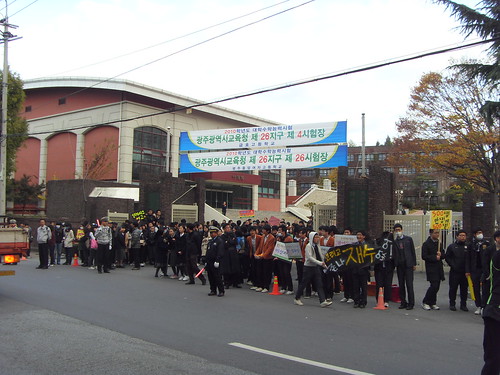
I left the house a little early on Thursday morning to catch some of the activities outside a local high school as students entered to take the college entrance exam (대학수학능력시험). It's the most important day in a student's life, and thus is a defining characteristic of the Korean education system. For an overview see the Wikipedia page, today's post by Chris in South Korea, my post from last year, and articles today in the Korea Times and Korea Herald.

Outside the school friends, parents, siblings, schoolmates, and teachers were there to cheer on the arriving students.

SDC19794

I got there around 7:45 AM, and found people outside the school waving signs, singing songs, pulling students onto school grounds, and passing out tea, chocolate, and candy to students and on-lookers. Parents often walked their children to the gates.

SDC19784
SDC19789
SDC19788

Students from several different schools were brought to this one for the exam, hence the different signs and different cheering sections.

SDC19790
SDC19785

I took a couple short videos just to capture the atmosphere.


There were police directing traffic, and motorcycle cops responsible for escorting late students to school.

SDC19800

Standing outside the school I saw a couple in action:


Things opened later on Thursday. People were asked to leave for work an hour later, city buses became students' shuttle buses to particular schools, and businesses opened later:

SDC19777

And in the afternoon some businesses were offering discounts to students who took the test:

SDC19803

Naver's got a collection of articles, pictures, and information on the day, and if you're interested in looking through the questions and answers, you can do so here by first choosing a site, then choosing a subject. (Last year's is here.)

It's beyond the scope of this post to attempt to write what the day means, so I'll simply say it was a neat experience to watch. It doesn't "puzzle" me, and it's not "too unique" for my foreign brain to comprehend; I think it was an important display to see to add context to what goes on in public schools. Granted, high school students here are under an enormous amount of pressure for this single exam, and over the next few days we'll read about lots of student suicides as a result. But I will say I was impressed with the enthusiasm shown on test day by schoolmates, friends, and family members. I know when I took final exams in school, or when I took the SAT, I didn't have people cheering me on. Nobody walked me to school, teachers didn't shake my hand, and underclassmen and last year's seniors weren't chanting my name from across the street. That sort of ovation was reserved for football games, and only for the cool kids.

For a test as big as Korea's 수능, I suppose it's only fitting that the welcoming party be just as grand.

Thursday, November 12, 2009

Insecurity makes headlines again as short men are called "losers" on "Misuda."


A short man is a 루저, says some woman I've never heard of.

From the Korea Times:
A remark deriding short men by a female student guest on KBS2 TV's talk show, ``Misuda,'' (Beauties' Chatterbox), is creating a stir on the Internet.

Lee Do-kyung of Hongik University, one of the 12 students invited to the program broadcast on Monday night, dropped a bombshell, saying a short man is a ``loser.''

Asked whether she would go out with a short male, she said, ``I won't. Height is a measure of competitiveness. I think a man who is short is a loser.'' She said a dating partner for her should stand at least 180 centimeters tall.

Right after her ``bold'' remark was aired, not only the student but also KBS homepage were bombarded with ruthless criticisms from netizens.

The following day, she posted a note on her mini-homepage on Cyworld that she just read the script.

``Script writers wanted me to follow the script and the word `loser' was in the script and I just read it as told,'' she said.

The last time we heard about the show being scripted was also the last time there was a controversy. In August a German panelist got into trouble with Korean netizens for writing a book with opinions deemed critical of Korea and Koreans (see this post for details). From the Korea Times:
As for her TV remarks, she said a half of them were pre-written by a writer. “You just memorize and regurgitate what is already scripted during the show,” she said.

Interestingly, in July when the panelists had a discussion about nasty foreign men, none of the Korean netizens seemed to notice or take offense. From a Korea Beat translation of an article:
UK-born Eva said, “foreign men who were not popular in their home countries are treated like kings… It’s so strange that western men who of course have very plan features are always being followed by pretty girls.”

Eva added, “if a Korean friend of mine is thinking about having a western boyfriend I tell her to let me see him first. Once my Korean friend’s boyfriend from the UK turned out to have a girlfriend back in the UK.”

I guess I have two things to say about the latest controversy: (1) so this woman is some random Korean person and isn't even a regular panelist? and (2) don't they rip on guys and stereotypes all the time? Isn't that one of the foundations of the show? Certainly, as we saw in July, some topics are considered proper for conversation on television---playing into the ugly stereotype of the foreign male "Playboy"---while a woman saying with shitty pronunciation that she doesn't like short guys clearly isn't.

Wednesday, November 11, 2009

Indians to teach English in Korean public schools from next year?

The Joongang Ilbo says so.
Starting in the fall semester next year, around 100 teachers from India will be teaching English at elementary, middle and high schools nationwide, a high-ranking official with the Education Ministry said yesterday.

The ministry has recently confirmed a plan to “improve the system for assistant native teachers of English,” including hiring English-speaking Indians.

“The Comprehensive Economic Partnership Agreement signed between Korea and India last Friday has opened a 1.2 billion-strong Indian market. We expect a number of qualified English teachers from India will come here,” said the source.

We've read before that the Indians are coming, but they haven't yet turned up in large numbers to teach English. Indians have found work teaching English camps and teaching English over the phone, although Kang Shin-who has written that non-native English speakers have not had luck finding jobs. Who knows if there are definite plans in place to hire Indian teachers, seeing as the source is unnamed in the Joongang Ilbo. This seems like another case of reporting possibility as probability.
The ministry will recruit around 100 Indians early next year and if the trial is successful, it could raise the number to 300. The source said there is a high chance that those teachers will be dispatched to regions outside the Seoul metropolitan area where there is a shortage of native English teachers.

Korean schools introduced the so-called English Program in Korea project in 1995 for “globalized education” and set the goal of allocating one native English teacher for conversation with students for every class. Currently, there are 7,088 assistant native English teachers employed but they are from seven English-speaking countries - the United States, Australia, Britain, Ireland, Canada, New Zealand and South Africa. Their monthly salary ranges between 2 million won ($1,700) and 2.5 million won.

The ministry has spent more than 300 million won a year on hiring and training those teachers but experienced difficulty gaining sufficient “qualified” teachers, given that only 13 percent of them have official teaching certificates.

I wrote about the misuse of "qualified" and "unqualified" in the Korea Herald in June, and have addressed it many times on this site, to such an extent that I thought we moved beyond that misnomer. I guess it bears repeating, for those who missed it the last few times around, that it is Korea itself that determined a four-year degree and the right passport are the qualifications for teaching English here. It is safe to say that nearly all the teachers in Korea are thus "qualified," and those who aren't slipped by a sleeping immigration. I'll quote at length from that Herald piece, though since you all have been through this a hundred times, feel free to skip a bit:
It is confusing to hear politicians and government officials talking about "unqualified teachers." After all, the government itself decided that nothing more than a passport from one of seven English-speaking countries and a bachelor's degree is necessary to teach English conversation on an E-2 visa. Schools, presumably, would like teachers with impressive resumes, so what is stopping the government from raising the standards? What's stopping schools from hiring better teachers?

Supply and demand is one reason. With English hagwon all over the place, and with more and more public schools after native speakers - or at least the funding that accompanies them - it is impossible to fill all these positions with experienced and trained teachers from native-English-speaking countries.

The language barrier is another, as most schools lack the English ability or the know-how to make reference checks or evaluate resumes. Furthermore, schools and school districts aren't willing to pay for quality, with public schools only offering an extra 200,000 won ($155) per month for teachers with a master's degree. Of course, teachers don't enter the profession to get rich, but since Korean teachers are among the highest-paid in the OECD, experienced and trained native speaker English teachers should be rewarded for teaching such a high-priority subject.

There are a couple of other points that undermine the overuse of "unqualified." Even today there are schools in Korea that refuse to hire blacks, Asians or overweight teachers, demonstrating how important the appearance of a native speaker still is. Each year we read about non-native speakers busted for teaching English illegally, which tells us that either the school couldn't detect a non-native accent, or that it was so eager to hire a foreign face that it didn't matter whether their English was any good.

However, a big reason Korea hasn't hired more "qualified" teachers is that it hasn't decided what a qualified English teacher really is, and thus doesn't know what to look for. The ambiguity of the word "unqualified" is in part a product of the ambiguous role native speakers play in the classroom.

From the Joongang Ilbo again:
Regarding concerns that some Indians who are fluent in English speak with local pronunciation and intonation, which has led to the term “Inglish,” the ministry will pick only those with teaching certificates of English and scrutinize the screening process through written and oral exams.

Well, we read last month that the school board in Yeosu city, Jeollanam-do, isn't hiring blacks or Asians, and we know that many phone hagwon advertise that they do not use Indians or other Asians, so we'll see how this goes.

However, I'm sure these teachers come cheaper, and I consider their introduction more indication---together with the new domestic English test, the thousands of Korean English "lecturers," and the increased contract funny business by public schools---that South Korea is moving away from hiring native speakers from the Big 7. Though thousands of native speaker English teachers have been hired for public schools over the years, a near-total lack of planning and support on the part of co-teachers, schools, and education offices has prevented them from reaching their full potential and has essentially set them up to fail. I suspect it won't be too long until the NSET experiment is over.

In the Korea Herald, writing about thoughtless English.

Based off recent posts like
* "Korean language evolves into Konglish?"
* "Hangeul still best Asian writing system for fucking up English word the least."
* "Happy 한글 Day."
* "Too much English in Korea? Yep, and don't look at us, it's not our fault."

is my latest piece in the Korea Herald, trotting out one of my hobby horses, the overuse of English in Korea. Here are a few excerpts:
I've been treated to some articles in the papers lately dealing with English in Korea and asking if there's too much of it, specifically in restaurants, on billboards, and on product labels. I strongly believe there's too much English used in Korea, that this overuse has negative consequences for students of English and regular citizens alike, and that it'd be healthy to use more Korean in Korean. However, one point I always like to make is that the overuse of English in Korea is a domestic phenomenon, one created and continued by Koreans, and any campaign to replace it ought to be a fight for thoughtful language use, not a crusade against a foreign invader.


Some of the English here is what I call "Gibberlish," a portmanteau of gibberish and English that means words or combinations of letters used for decoration. Gibberlish is found when online translation tools are used, creating a meaningless arrangement of words such the sign in Suncheon that reads "Rain blood vessel & skin the government serviece." It is found in pop songs, where rappers and singers will randomly insert English words and phrases, and it exists to such a great extent in the fashion industry that it's tough to buy a t-shirt without ridiculous English on it.

Because much of the English in Korea doesn't make sense to native speakers, isn't created with the intention of being correct or comprehensible, and certainly isn't understood by Koreans, it's fair to ask, why use it at all?

I first read about The National Institute of the Korean Language last week, and the webpage on which they offer suggested replacements for imported "English" terms. I like what they're about: after all, why the impulse to borrow words when Korean ones are perfectly suitable? Their website might be translated as "Pruning Our Language Together" (모두가 함께하는 우리말 다듬기), and you can take a look at some of the words recently reviewed here.
But what I'd really like to emphasize is the recent changes to "Our Language" were brought about by Koreans, and campaigns to prune it shouldn't be waged against English itself or its speakers, but rather against the thoughtless use of it. It's Koreans who choose to import these words, to use mangled English instead of Korean, to write their advertisements without Hangeul, to isolate Korean speakers, and to limit their language's creative power. This isn't a foreign invasion, and any efforts at Koreaning-up the Korean language really ought to be a fight against incomprehension and thoughtless language use, rather than a xenophobic one against a foreign language.


From August, 2008.

This day in history: Iri Station Explosion.

In Korea, November 11th is Pepero Day---or Garaetteok Day, depending---though it's also the anniversary of a large man-made disaster, the Iri Station Explosion (이리역폭발사건).

About the only significant bit of information I can find in English comes "Emergency Management in Korea: Just Started, but Rapidly Evolving," [.doc] a chapter in the Comparative Emergency Management Book Project available online from the United States Federal Emergency Management Agency [FEMA] website.
A blast occurred in a train with 40-ton explosives at Iri Station at 9:15 pm on November 11, 1977. As a result, 59 people were killed, 185 people were seriously injured, and 1,158 people were slightly injured. The Iri station explosion was a man-made disaster, considering the mistake of one drunken guard who was careless with the dynamite on the train. When he attempted to ignite the candle, he mistakenly set the fire to dynamite. The total number of emergency responders reacting to the explosion and help recover from this disaster was 107,787. In particular, military personnel, including not only the current soldiers but also the national guards, played many important roles in response and recovery. Through this disaster experience, cooperation with military force was deeply emphasized.

Here are a couple pictures of the scene:


You can probably view some other pictures via a Google Image search, though there's not much out there. Another picture I tried to retrieve was on an Empas blog that caused Internet Explorer to crash and caused me to lose over an hour's worth of work on this post, so I'd advise against it. There's really not much available in English, and in fact the only other substantial write-up I've found was on GordSellar.com in 2008; an excerpt:
Actually, Iksan is a great microcosm of development in Korea. Downtown (not pictured above) was all new and modern, with big multi-lane roads, a shopping district laid out relatively logically (that is, on a grid) and it was easy to navigate, get around in, and so on. The reason for this, however, was awful: one night in November 11th, 1977 — when the town (or at least the train station) was still normally called by its old name, “Iri” — there was an accident at the train station. The way I heard it, someone was moving crates in a military shipment — unmarked, of course, for security reasons, right? — and he discovered what was in the crates when his cigarette lit them, and the crates exploded.

I don’t know whether that’s true, of course — how would anyone know that it was this or that guy, whether he was smoking or just, you know, dropped a crate? And would the ask of a cigarette actually set off dynamite? Isn’t it just as likely that a box got dropped and blew up? I don’t know, but this is exactly the kind of tangled urban legend that grows up around these kinds of events. But the effect is incontestable. The account on Wikipedia (in Korean only) suggests, if I’m getting it right, that someone lit a candle or lantern while moving the crates at night, which contained about forty tons of high explosives. They weren’t supposed to have been there, but they were.

In any case, an older gentleman I knew in Iksan told me he was drinking soju with his buddies in Jeonju when it happened, and they heard the sound of the blast. From a distance of about 20 kilometers away, they heard the sound so clearly that it overpowered all the conversation in the establishment where they were drinking, as well as the TV. Boom. They didn’t know it then, but downtown Iksan had just been smashed apart, or, at least, the area immediately in front of the train station had been destroyed.

I first got on this trail ages ago when I noticed a picture in the Gwangju bus terminal of a bus going to Iri.


It caught my attention both because I had never heard of it and because, coincidentally, there's a lake and a town Erie in Pennsylvania. Korea's Iri city (이리시) doesn't exist anymore, because it and Iksan county were merged into Iksan city, Jeollabuk-do, in 1995. As far as I can tell, from this Naver encyclopedia page, a new station opened in Iri in 1978, and it, too, changed its name in 1995.

Tuesday, November 10, 2009

Fall colors on Gangcheonsan.

Took a trip to Sunchang county's Gangcheonsa (강천사) on Halloween, and while Seoul was getting rained on we enjoyed a perfect fall day. I should say we took a trip to Gangcheonsan (강천산); we never made it all the way up the trail to the temple.

You'll can browse the 94 pictures in the Flickr gallery at your leisure; here are a few:

SDC19558
SDC19568
SDC19569
SDC19574
SDC19583
SDC19586

The water in the creek was remarkably clear:

SDC19594
SDC19607
SDC19614
SDC19617
SDC19620
SDC19622
SDC19649
SDC19639

Here's what's available from a Naver search. The reds and oranges were striking. And the reds, oranges, greens, and pinks on the track suits were remarkable, too.

It's a 90-minute bus ride to Gangcheonsa from Gwangju. I'm not sure how long it takes to hike to the temple because after about a ninety-minute stroll we didn't seem to be anywhere near it. There is course information and maps available here from 한국의산하. You'll find a timetable for buses to and from Gwangju here; the times given on the Gwangju Bus Terminal website don't seem to be accurate.

Gangcheonsa came highly recommended from my Korean teacher, though we settled on it because the buses to and from Daewonsa in Boseong county were a bit inconvenient. But the scenery was a happy surprise, as was the weather, and I'll be sure to talk-up the place a little more on next year's regional fall foliage preview.


I'll use my 2,000th post on Brian in Jeollanam-do to tell you that this week's column in the Joongang Ilbo was compiled from comments to October 23rd's "Beware of cultural tips," about the weird stuff you find in teachers' guides and textbooks.